You have 0 items in your cart

Original price was: ₹750.00.₹700.00Current price is: ₹700.00.
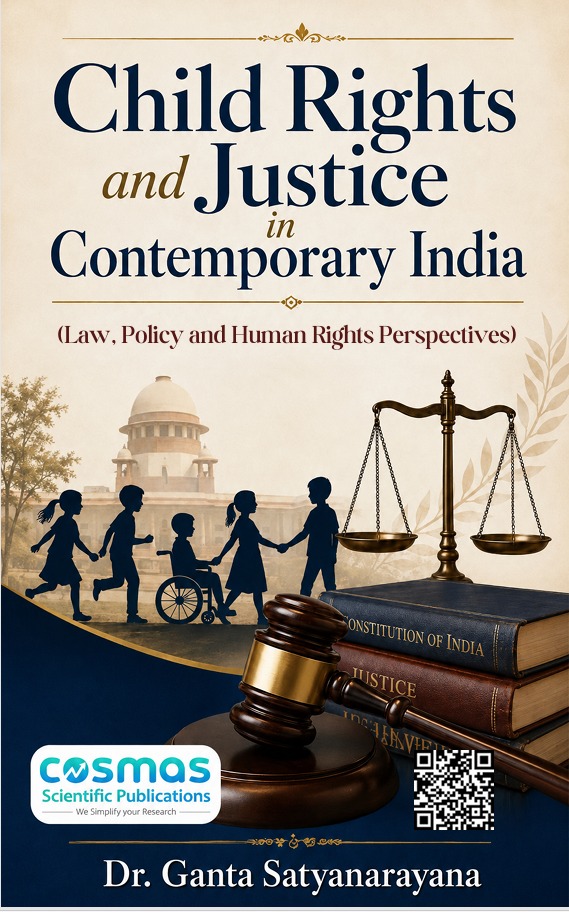
Authors: Dr. GANTA SATYANARAYANA
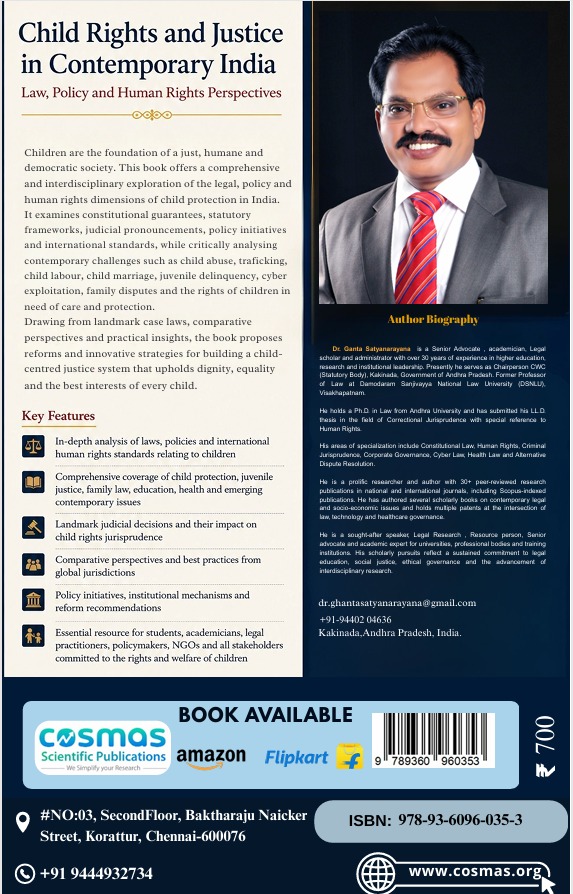
Children are the most precious assets of every nation and the architects of its future. Their physical, intellectual, emotional, moral, and social development determines the strength and sustainability of a democratic society. Ensuring that every child enjoys the rights to life, dignity, equality, education, health, protection, and holistic development is not merely a constitutional obligation but a moral responsibility shared by the State, the family, the community, and every citizen. The Constitution of India envisions a social order founded upon justice, liberty, equality, and fraternity. Embedded within this constitutional philosophy is a deep commitment to safeguarding the rights and welfare of children. Over the years, India has enacted progressive legislation, established specialized institutions, and adopted numerous national and international commitments aimed at protecting children from exploitation, abuse, neglect, trafficking, violence, discrimination, and all forms of deprivation. Despite these remarkable legal developments, millions of children continue to encounter challenges arising from poverty, child labour, child marriage, sexual abuse, trafficking, family disintegration, educational inequality, cyber exploitation, homelessness, conflict with law, and inadequate access to justice. The growing complexity of contemporary society has introduced new dimensions to child protection. Rapid technological advancements, increased internet accessibility, social media platforms, artificial intelligence, cybercrime, migration, environmental disasters, and changing family structures have significantly transformed the nature of risks faced by children. These emerging realities require continuous evaluation of existing legal frameworks and the development of innovative, child-centred policies capable of responding effectively to evolving challenges. The inspiration for this book emerged from my long association with legal education, academic research, classroom interaction, and the study of constitutional law, criminal justice administration, human rights, juvenile justice, family law, and child protection. Throughout my academic career, I have observed that although substantial literature exists on individual aspects of child rights, there remains a pressing need for a comprehensive work that integrates constitutional principles, statutory provisions, judicial interpretation, international human rights standards, institutional mechanisms, and contemporary policy developments within a single volume. This book is an endeavour to fulfil that need. The objective of this work is not merely to explain the law but to critically examine the practical realities surrounding the protection of children in contemporary India. It seeks to analyse the effectiveness of existing legal mechanisms, identify gaps in implementation, evaluate judicial responses, and propose reforms that promote a more humane, inclusive, and child-centred justice system. The book recognizes that child rights extend far beyond legal entitlements; they encompass human dignity, social justice, equality of opportunity, and the creation of an environment in which every child can develop to his or her fullest potential. The book is systematically organized into thematic chapters that trace the historical evolution of child rights, constitutional safeguards, international legal standards, statutory protections, juvenile justice administration, child welfare mechanisms, family law, education, health, child labour, trafficking, sexual offences against children, adoption, guardianship, children in need of care and protection, children in conflict with law, comparative international practices, landmark judicial pronouncements, public policy initiatives, and emerging challenges in the digital age. Each chapter combines doctrinal legal analysis with contemporary developments and practical perspectives, thereby providing readers with both conceptual clarity and analytical depth. Special emphasis has been placed on recent legislative developments, judicial innovations, policy initiatives, and institutional reforms that seek to strengthen child protection in India. The discussion incorporates constitutional jurisprudence, decisions of the Supreme Court and various High Courts, international conventions, reports of expert committees, recommendations of national commissions, government policies, and comparative legal experiences from different jurisdictions. This multidisciplinary approach reflects the understanding that the protection of children cannot be achieved through legal measures alone but requires coordinated action by governments, courts, educational institutions, healthcare professionals, social workers, law enforcement agencies, civil society organizations, and families. This book has been prepared with the needs of a diverse readership in mind. It is intended to serve as a valuable resource for undergraduate and postgraduate students of law, research scholars, academicians, advocates, judicial officers, public prosecutors, police officers, members of Juvenile Justice Boards, Child Welfare Committees, child rights commissions, administrators, policymakers, social workers, non-governmental organizations, and all individuals committed to promoting the welfare and protection of children. No scholarly work is created in isolation. It represents the cumulative wisdom of distinguished jurists, constitutional thinkers, judges, legislators, researchers, international organizations, governmental institutions, and countless child rights advocates whose contributions have shaped the evolution of child rights jurisprudence across the world. I acknowledge, with profound respect and gratitude, the invaluable scholarship and public service rendered by these eminent personalities and institutions, whose work has greatly enriched this study. I express my heartfelt gratitude to my respected teachers, colleagues, fellow academicians, research scholars, students, and professional associates for their continuous encouragement, constructive criticism, and intellectual support throughout the preparation of this manuscript. Their insights and discussions have significantly contributed to the development of many ideas presented in this book. I owe my deepest gratitude to my beloved family, whose unwavering love, patience, understanding, encouragement, and countless sacrifices have remained the greatest source of strength throughout my academic and professional journey. Their faith in my work has inspired me to pursue scholarship with dedication and perseverance. I also express my sincere appreciation to the Government of India, the Judiciary, the Ministry of Women and Child Development, the National Commission for Protection of Child Rights, State Commissions, UNICEF, the United Nations, the International Labour Organization, academic institutions, and numerous governmental and non-governmental organizations whose reports, publications, research studies, and policy initiatives have provided valuable guidance in the preparation of this work. Although every effort has been made to ensure that the contents of this book are accurate, comprehensive, and up to date, the law relating to child rights continues to evolve through legislative reforms and judicial interpretation. Consequently, any inadvertent errors or omissions are entirely my own. I shall gratefully welcome constructive suggestions and scholarly observations from readers, which will be invaluable for improving future editions. It is my earnest hope that this book will contribute meaningfully to legal scholarship, enrich academic discourse, support evidence-based policymaking, strengthen the administration of child justice, and inspire greater commitment towards protecting the dignity, rights, and holistic development of every child. If this work succeeds in creating even a small measure of awareness and encourages collective action for safeguarding childhood, the efforts invested in its preparation will have been richly rewarded.
Dr. Ganta Satyanarayana
Professor of Law
| Format | Paperback |
|---|---|
| Date of publishing | August 2026 |
| Lanuguage | English |
| No.of pages | 463 |