You have 0 items in your cart

Original price was: ₹550.00.₹500.00Current price is: ₹500.00.
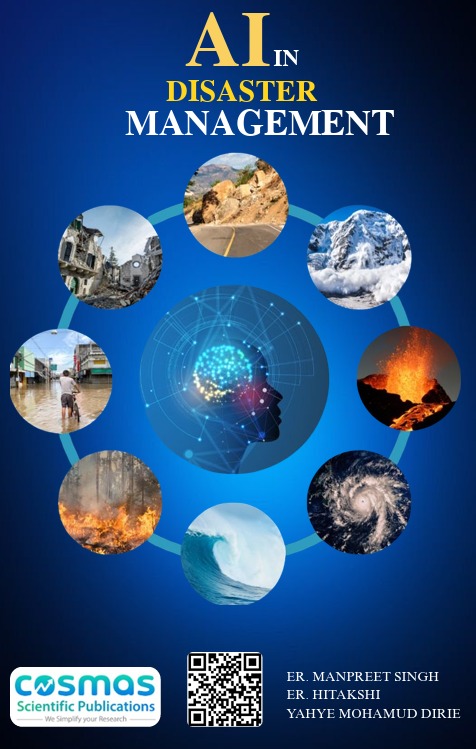
Authors: ER. MANPREET SINGH, ER. HITAKSHI, YAHYE MOHAMUD DIRIE
Disasters are not merely natural phenomena; they are socially constructed events that emerge from the interaction between hazardous events and the vulnerable conditions of exposed communities. Floods, earthquakes, landslides, cyclones, wildfires, droughts, and extreme weather events continue to cause widespread human, material, economic, and environmental losses across the globe. As climate change intensifies hazard events, urbanization concentrates populations in vulnerable areas, and technological systems become increasingly complex and interdependent, the need for sophisticated disaster management capabilities has never been greater. This book explores the transformative role of Artificial Intelligence (AI) in disaster management. It examines how AI technologies—including machine learning, deep learning, computer vision, natural language processing, robotics, and expert systems—are being applied across all phases of the disaster management cycle: mitigation, preparedness, response, and recovery. The integration of AI with remote sensing, Geographic Information Systems (GIS), Internet of Things (IoT) sensors, cloud computing, and real-time analytics offers unprecedented opportunities for predicting, preparing for, responding to, and recovering from disasters. The book is organized into eleven chapters that progressively build the reader’s understanding of this interdisciplinary field. Chapter 1 establishes the foundational concepts of disasters, the disaster management cycle, and the evolution of disaster management technologies. Chapter 2 introduces the fundamentals of AI, machine learning, deep learning, and neural network architectures, with a focus on their relevance to disaster applications. Chapter 3 examines AIbased disaster risk assessment and hazard mapping, integrating geospatial information, environmental observations, and computational models. Chapters 4 through 8 address specific disaster types: floods, earthquakes, landslides, cyclones and extreme weather events, and wildfires, droughts, and climate-related disasters. Each chapter presents AI applications, case studies, numerical examples, and integrated frameworks tailored to the unique characteristics of these hazards. Chapter 9 explores the synergy between remote sensing, GIS, and AI for disaster mapping and damage assessment. Chapter 10 focuses on IoT, sensors, and real-time AI-based disaster monitoring, emphasizing edge computing, cloud platforms, and early-warning systems. Chapter 11 presents an integrated AI framework, case studies from India and internationally, performance evaluation metrics, challenges, research gaps, and future directions. Throughout the book, a critical distinction is maintained: AI should not be viewed as a replacement for human judgment, field observations, engineering expertise, or disaster management experience. Rather, AI serves as a powerful complement—augmenting human capabilities, improving the speed and consistency of information processing, and supporting evidence-based forecasting, monitoring, response, and recovery. The most effective disaster management architecture integrates AI with hydrological and hydraulic modelling, seismology, structural engineering, geotechnical engineering, meteorological science, and institutional decision-making. The book emphasizes several cross-cutting themes. First, the relationship between hazard, vulnerability, exposure, and risk provides the analytical foundation for disaster risk assessment. The formula Risk = (Hazard × Vulnerability × Exposure) / Capacity demonstrates that risk can be reduced through strategic interventions that decrease vulnerability and exposure or increase capacity. Second, data quality, algorithmic bias, infrastructure requirements, trust deficits, privacy concerns, capacity gaps, interoperability problems, and regulatory uncertainty must all be addressed for AI to achieve its full potential. Third, explainable AI techniques such as SHAP and feature-importance analysis help address the “black box” problem by revealing which variables drive predictions, thereby supporting transparency and decision-maker trust. The book draws on numerous case studies and numerical examples from India and around the world. These include flood forecasting in the Brahmani-Baitarani basin, flood susceptibility mapping in Prayagraj, CNN-LSTM models in the Beijing River Basin, Google’s global AI flood forecasting system, Tehran’s urban drainage optimization, earthquake early warning in Japan, wildfire management in the United States, and landslide risk assessment in the Himalayan region. These examples illustrate both the potential and the limitations of AI in real-world disaster management contexts. Looking forward, the integration of AI with IoT, cloud computing, digital twins, unmanned aerial vehicles, edge computing, big-data analytics, real-time GIS, high-resolution climate models, and explainable AI promises to move disaster management from reactive response toward proactive, predictive, and continuously updated risk assessment. Such systems can support timely early warning, adaptive planning, and more resilient communities in an era of changing climate and growing exposure. This book is intended for students, researchers, practitioners, and policymakers in disaster management, civil engineering, environmental science, computer science, geoinformatics, and related fields. It assumes no prior expertise in AI but provides sufficient technical depth to enable readers to understand and apply AI techniques in disaster management contexts. Each chapter includes tables, figures, mathematical formulations, and practical examples to facilitate learning and application. The ultimate objective of AI in disaster management should not simply be to produce more sophisticated predictions. The objective should be to convert data into timely knowledge, knowledge into informed decisions, and decisions into actions that protect lives, infrastructure, ecosystems, and livelihoods. If this book contributes in some small measure to that goal, it will have served its purpose. -Authors
| Format | Paperback |
|---|---|
| Date of publishing | October 2026 |
| Lanuguage | English |
| No.of pages | 283 |