You have 0 items in your cart

Original price was: ₹550.00.₹500.00Current price is: ₹500.00.
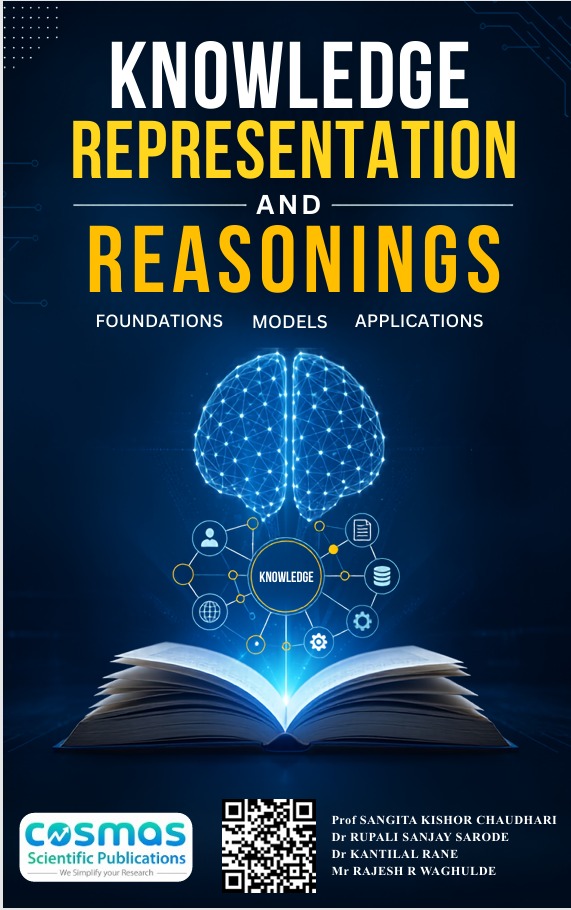
Authors: Prof SANGITA KISHOR CHAUDHARI, Dr RUPALI SANJAY SARODE, Dr KANTILAL RANE, Mr RAJESH R WAGHULDE
Artificial Intelligence (AI) has emerged as one of the most transformative technologies of the modern era, influencing diverse domains such as healthcare, education, business, manufacturing,
robotics, and intelligent decision-making systems. At the heart of Artificial Intelligence lies the ability of machines to represent, organize, process, and reason with knowledge in a manner that emulates human cognitive capabilities. Knowledge Representation and Reasoning (KRR) form the foundation upon which intelligent systems are built, enabling computers to understand complex information, draw logical conclusions, make informed decisions, and solve real-world problems. This book, “Knowledge Representation and Reasoning,” has been carefully designed to provide a comprehensive understanding of the principles, techniques, and applications of knowledge representation in Artificial Intelligence. It introduces readers to the fundamental concepts of knowledge, various methods of representing knowledge, and the reasoning mechanisms that allow intelligent systems to derive meaningful conclusions from available information.
The book begins with the foundations of knowledge representation, including the nature of knowledge, knowledge acquisition, knowledge engineering, and methodologies used for constructing intelligent knowledge-based systems. It then explores formal representation techniques such as Predicate Logic and First Order Logic, which provide the mathematical framework for expressing facts, rules, and relationships within a domain. Subsequent chapters discuss Semantic Networks, Frames, Scripts, Ontologies, and modern knowledge organization approaches that enable efficient representation of structured and unstructured information. The book also presents uncertainty management and probabilistic reasoning techniques, including Bayesian Networks and Decision Networks, which play a vital role in handling incomplete and uncertain information encountered in real-world applications. A significant emphasis is placed on Description Logics, Ontology Engineering, Semantic Web technologies, Linked Data, and reasoning mechanisms that support intelligent knowledge-based applications. Advanced topics such as Knowledge Graphs, Common-Sense Reasoning, Non-Monotonic Logic, Natural Language Processing, Expert Systems, Temporal and Spatial Knowledge Representation, and emerging trends in Explainable Artificial Intelligence are also discussed to provide readers with a broader perspective of current developments in the field. The contents have been organized in a systematic and learner-friendly manner, combining theoretical foundations with practical examples, applications, and case studies. This approach enables students, researchers, academicians, and professionals to develop both conceptual understanding and practical insights into designing intelligent systems capable of representing and reasoning with knowledge effectively.
This book is intended primarily for undergraduate and postgraduate students of Computer Science, Artificial Intelligence, Data Science, Information Technology, and related disciplines. It
will also serve as a useful reference for researchers, practitioners, and professionals seeking a deeper understanding of knowledge-based systems and intelligent reasoning methodologies. The authors sincerely hope that this book will assist readers in exploring the fascinating world of Knowledge Representation and Reasoning and inspire them to contribute to the advancement of intelligent technologies that shape the future of Artificial
Intelligence.
– Authors
| Format | Paperback |
|---|---|
| Date of publishing | July 2026 |
| Lanuguage | English |
| No.of pages | 470 |