You have 0 items in your cart

Original price was: ₹550.00.₹500.00Current price is: ₹500.00.
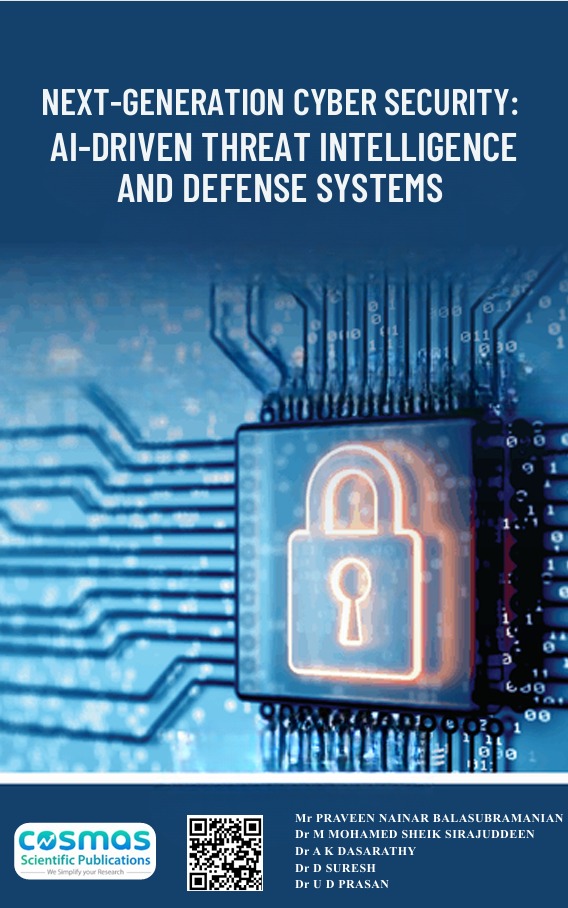
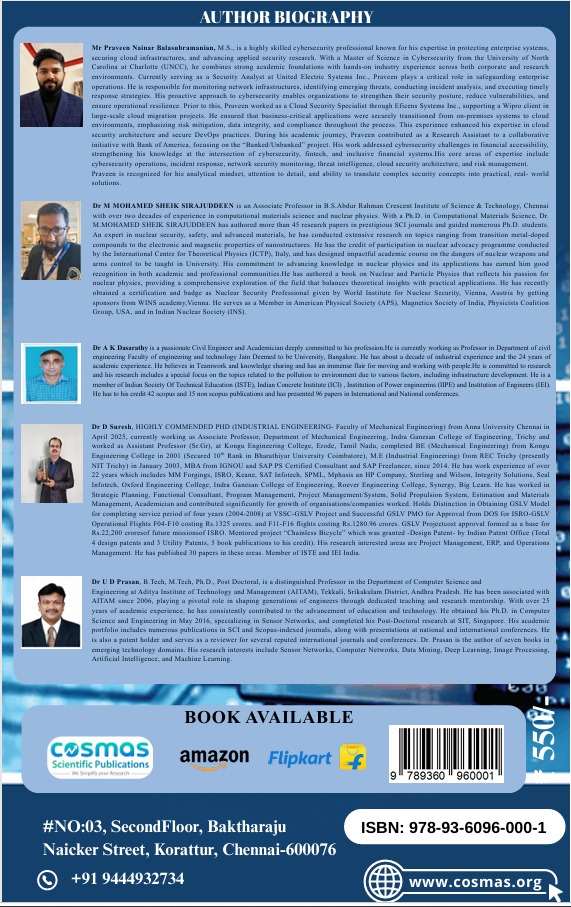
Authors: Mr PRAVEEN NAINAR BALASUBRAMANIAN, Dr M MOHAMED SHEIK SIRAJUDDEEN, Dr A K DASARATHY, Dr D SURESH, Dr U D PRASAN
The digital landscape has undergone a radical transformation over the past decade, evolving from a network of distinct, interconnected computers into an expansive, hyper-connected global
ecosystem. Today, cloud computing, the Internet of Things, and distributed edge infrastructure serve as the backbone of modern civilization. Yet, this rapid technological expansion has introduced an unprecedented level of vulnerability. Cyber threats are no longer isolated incidents of amateur digital vandalism; they have matured into sophisticated, highly orchestrated operations fueled by advanced malware, global ransomware syndicates, and heavily funded nation state Advanced Persistent Threats. As traditional signature-based security barriers buckle under the sheer volume, velocity, and complexity of modern attacks, the cybersecurity paradigm must fundamentally shift from reactive mitigation to proactive, intelligent, and autonomous defense. This book, titled Next-Generation Cyber Security: AI-Driven Threat Intelligence and Defense Systems, is written to address this critical evolutionary milestone, providing an authoritative roadmap for integrating Artificial Intelligence and Machine Learning into the core of modern defensive architectures. To guide researchers, practitioners, and advanced students through this complex domain, the text is structured systematically into five distinct thematic phases. It begins by establishing the foundational baseline of modern cybersecurity and artificial
intelligence, charting the historical evolution of threat landscapes, and exploring the operational gaps within traditional Security Operations Centers that current technologies fail to close. From there, the book breaks down the specific algorithmic engines driving modern security, offering deep technical insight into how supervised, unsupervised, and reinforcement learning—alongside advanced deep learning architectures like Convolutional and Recurrent Neural Networks—can be leveraged for complex pattern recognition and adaptive defense. The narrative then transitions from mathematical theory to architectural execution, focusing on the mechanics of Cyber Threat Intelligence, behavioral analytics, automated threat hunting, and the deployment of AI-powered intrusion detection systems. As the technical framework solidifies, the focus shifts toward structural design patterns and real-world deployment applications. Readers will explore the implementation of Zero Trust Security Architectures, AI-powered network and endpoint detection, and specialized strategies for safeguarding critical infrastructure, industrial control systems, cloud containers, and IoT ecosystems. Finally, the book confronts the dual-use nature of these emerging technologies by addressing the rising challenge of adversarial AI and AI-powered cyberattacks. It provides an honest evaluation of algorithmic bias, transparency through Explainable AI, legal regulations, and data governance, before concluding with a forward
looking analysis of post-quantum cryptography and the ultimate realization of truly autonomous, self-healing cyber defense systems. Several critical themes run continuously through this volume, most notably the automation paradox. As attackers increasingly leverage generative models and automation to discover vulnerabilities at machine speed, defenders can no longer rely solely on human intervention. This book emphasizes a balanced model of human-AI collaboration, positioning intelligent systems as analytical multipliers that parse massive data streams so that human experts can focus on high-level strategic decisions. Furthermore, by blending rigorous technical exposition with diverse international case studies, this text moves beyond theoretical speculation to offer practical, real world context. Ultimately, this work serves as a definitive resource for security engineers, chief information security officers, and academic researchers who require the comprehensive knowledge necessary to navigate, build, and defend the digital frontiers of tomorrow.
| Format | Paperback |
|---|---|
| Date of publishing | June 2026 |
| Lanuguage | English |
| No.of pages | 371 |