You have 0 items in your cart

Original price was: ₹550.00.₹500.00Current price is: ₹500.00.
Authors: Dr NIVEDITA S PADOLE, Mr TALASILA VENKATESH, Dr GEETHA AIYYANARAPAN, Mr PRAVIN LAXMAN GHOLAVE, Dr P U POORNIMA
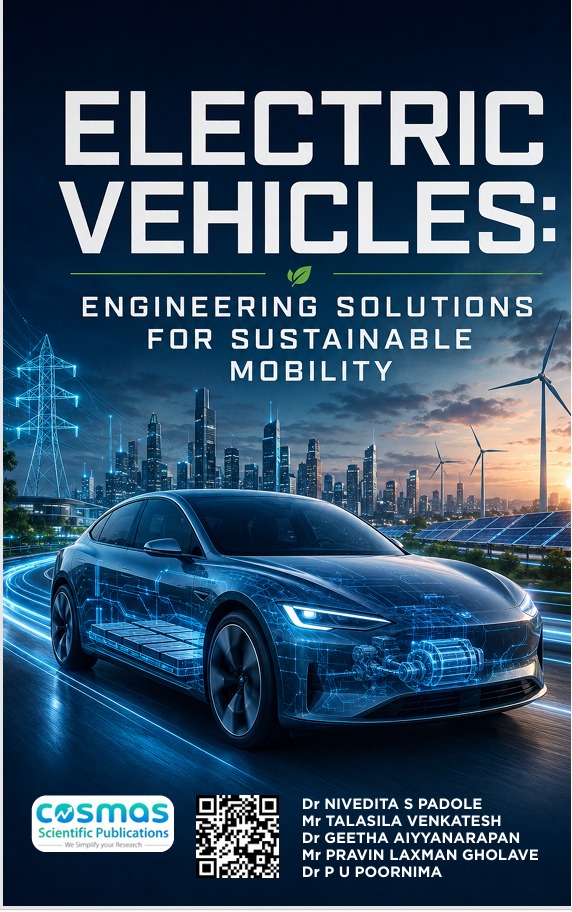
The dawn of the 21st century has brought humanity to a critical turning point, compelling the global community to confront the growing challenges of climate change and the finite availability of fossil fuels. Among all sectors, transportation—once a major driver of industrial development and economic growth—has emerged as a key area requiring transformative change. Electric Vehicles: Design, Technology, and Solutions for Sustainable Mobility is conceived in response to this urgent need. The book provides a comprehensive overview of the rapidly evolving electric mobility landscape, examining the transition not simply as a shift in energy sources but as a fundamental transformation of the automotive ecosystem. For more than a century, internal combustion engines have shaped transportation systems, influenced urban development, and supported economic expansion. However, their widespread use has also contributed significantly to environmental degradation, greenhouse gas emissions, and dependence on finite energy resources. The current transition toward vehicle electrification represents a major technological shift that brings together disciplines such as electrical and mechanical engineering, materials science, energy systems, urban planning, and public policy. This book aims to connect these diverse perspectives by combining the technical principles behind electric vehicles with their environmental, economic, and societal implications. The book begins by presenting the history and evolution of transportation technologies, with particular emphasis on the early development, decline, and modern resurgence of electric propulsion. It then explores the fundamental architecture of contemporary electric vehicles, including electric powertrains, motor technologies power electronics, control systems, and Battery Management Systems. Particular attention is given to battery technology, which remains one of the most important components of electric mobility. The discussion covers established lithium-ion technologies as well as emerging developments such as solid-state batteries, advanced energy-storage systems, and rapid-charging technologies, offering insights into the future direction of electric vehicle energy systems.
The transition to electric mobility extends beyond the vehicle itself and requires a reliable and intelligent supporting infrastructure. Accordingly, the book examines charging technologies, charging networks, smart-grid integration, and the role of renewable energy in supporting sustainable transportation. It also considers emerging developments at the intersection of electric mobility with autonomous driving, connected transportation, shared mobility, and smart-city development. In addition, lifecycle assessment and carbon-emission analysis are discussed to provide a broader understanding of the environmental benefits and limitations associated with electric vehicles. A significant focus is placed on the global development of electric mobility, considering the different strategies and adoption pathways followed by developed and emerging economies. Particular attention is given to India, where rapidly evolving transportation needs,
infrastructure development, energy availability, and government policies create both unique challenges and significant opportunities for electric vehicle adoption. Such regional perspectives demonstrate the importance of developing mobility solutions that reflect local economic, technological, environmental, and social conditions. Despite the considerable potential of electric vehicles, sustainable mobility continues to face challenges, including the availability of critical battery materials, manufacturing costs, charging infrastructure, battery recycling, energy requirements, and consumer concerns regarding driving range and charging time. Rather than viewing these issues as barriers to progress, this book approaches them as opportunities for technological innovation, policy development, and interdisciplinary research. As transportation systems move toward greater electrification, connectivity, automation, and sustainability, the need for informed technological and strategic decision-making will continue to grow. This book is intended to serve as a valuable reference for engineers, researchers, students, policymakers, industry professionals, and anyone interested in the future of sustainable transportation. By bringing together technological developments, environmental considerations, infrastructure requirements, and policy perspectives, it seeks to provide both a roadmap and a source of inspiration for building a cleaner, smarter, and more sustainable mobility ecosystem.
-Authors
| Format | Paperback |
|---|---|
| Date of publishing | August 2026 |
| Lanuguage | English |
| No.of pages | 309 |