You have 0 items in your cart

Original price was: ₹550.00.₹500.00Current price is: ₹500.00.
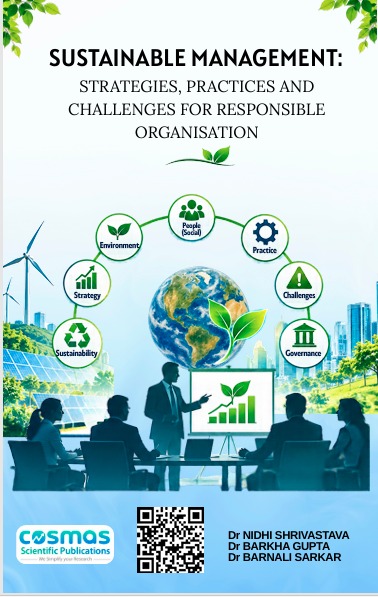
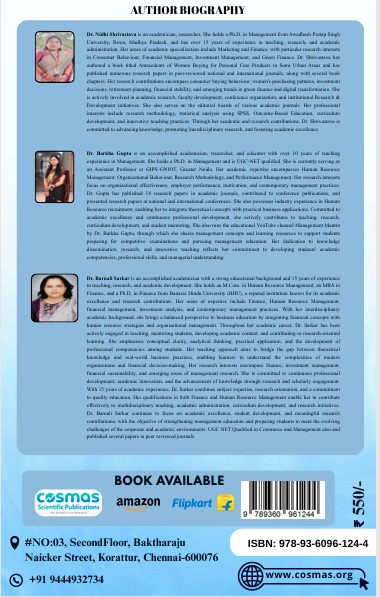
Authors: Dr NIDHI SHRIVASTAVA, Dr BARKHA GUPTA, Dr BARNALI SARKAR
Sustainability has become an important consideration in the way organisations define their purpose, make decisions and plan for the future. Economic performance can no longer be considered in isolation from environmental responsibility, social well-being, ethical conduct and the expectations of stakeholders. Organisations depend on natural resources, people, institutions and communities; their long-term success is therefore closely connected with the responsible management of these relationships. This book, centred on
sustainable management, brings together key concepts, managerial approaches and practical areas through which sustainability can be understood and incorporated into organisational practice. The purpose of this book is to develop a clear and integrated understanding of sustainability as both a management responsibility and a long-term organisational priority. It introduces the foundations of sustainable management and explores how sustainability can influence strategy, leadership, governance, human resource management, finance, operations, supply chains and wider organisational responsibilities. Across these areas, a consistent theme emerges: sustainability is most effective when it is embedded in everyday decisions and organisational systems rather than treated as a separate programme or a matter of public communication alone. The opening chapters establish the conceptual basis for this discussion. They examine the meaning and evolution of sustainable management, the relationship between sustainability and sustainable development, and the economic, social and environmental dimensions commonly expressed through the Triple Bottom Line of People, Planet and Profit. They also consider stakeholder theory, responsible management and the Sustainable Development Goals, providing a foundation for understanding why organisations must consider the wider consequences of their activities and the interests of those affected by them. The book then turns to the organisational mechanisms that translate these principles into practice. Sustainable strategy, leadership and corporate governance are considered alongside green human resource management, including the role of recruitment, employee development, participation and workplace culture. These discussions highlight that sustainability depends not only on policies, technologies and targets, but also on leadership commitment and the knowledge, capabilities and everyday choices of people throughout an organisation. Further chapters extend the discussion to sustainable finance and environmental, social and governance considerations; sustainable operations and green supply chain management; and corporate social responsibility and related approaches to organisational accountability. These themes demonstrate how sustainability can influence investment, resource use, production, procurement, logistics, reporting, community engagement and relationships with stakeholders. They also show that environmental and social considerations are interconnected with organisational resilience, innovation, risk management and long-term value creation. A central concern throughout the book is the practical difficulty of putting sustainability commitments into effect. Organisations may face financial constraints, competing short-term pressures, changing regulations, limited data, technological barriers, gaps in expertise and resistance to change. They must also guard against greenwashing by ensuring that claims about performance are credible, transparent and supported by evidence. Addressing these challenges calls for clear objectives, appropriate measures, stakeholder engagement, responsible governance and a willingness to learn and improve over time. The chapters also draw attention to emerging areas that are reshaping the sustainability agenda, including circular economy approaches, renewable energy, digital technologies, artificial intelligence, climate resilience, sustainability reporting and sustainable business innovation. These developments create opportunities, but they also require careful judgement. Technology and innovation can support better decisions and more efficient use of resources; their value, however, depends on how they are designed, governed and applied in relation to broader social and environmental goals. The book is intended to be useful to students, teachers, researchers and readers interested in management and sustainable organisational development. Its
conceptual explanations, structured themes and illustrative examples are designed to support learning and discussion, while helping readers connect broad sustainability principles with managerial decisions. It may also serve as a starting point for further study, classroom debate and the examination of sustainability practices in different organisational and industry contexts. Sustainable management is not a fixed formula that can be applied identically in every setting. Organisations differ in size, purpose, resources, location and stakeholder relationships, and their priorities must be understood in context. Nevertheless, the underlying task is shared: to pursue economic viability while respecting people, protecting the environment and considering the consequences of present decisions for the future. Progress requires both strategic direction and consistent action, supported by accountability and meaningful participation. It is hoped that this book will encourage readers to approach sustainability not as a peripheral obligation, but as an integral part of sound management and responsible decision-making. By connecting concepts with organisational functions and contemporary challenges, it seeks to support a more thoughtful understanding of how organisations can create value while contributing to a more inclusive, resilient and sustainable future.
– Authors
| Format | Paperback |
|---|---|
| Date of publishing | November 2026 |
| Lanuguage | English |
| No.of pages | 269 |